
"Train Up a Child in the Way He Should Go" — What Proverbs 22:6 Really Means
18th Feb 2026
What Does "Train Up a Child" Actually Mean?
Proverbs 22:6 is one of the most quoted, most displayed, and most misunderstood verses in the Bible.
Parents put it on nursery walls, cross-stitch it onto pillows, and carry it as a personal promise from God. But the original Hebrew says something richer — and more nuanced — than most English translations let on.
Here's the full verse, what it meant in its original language, and why it still matters 3,000 years later.
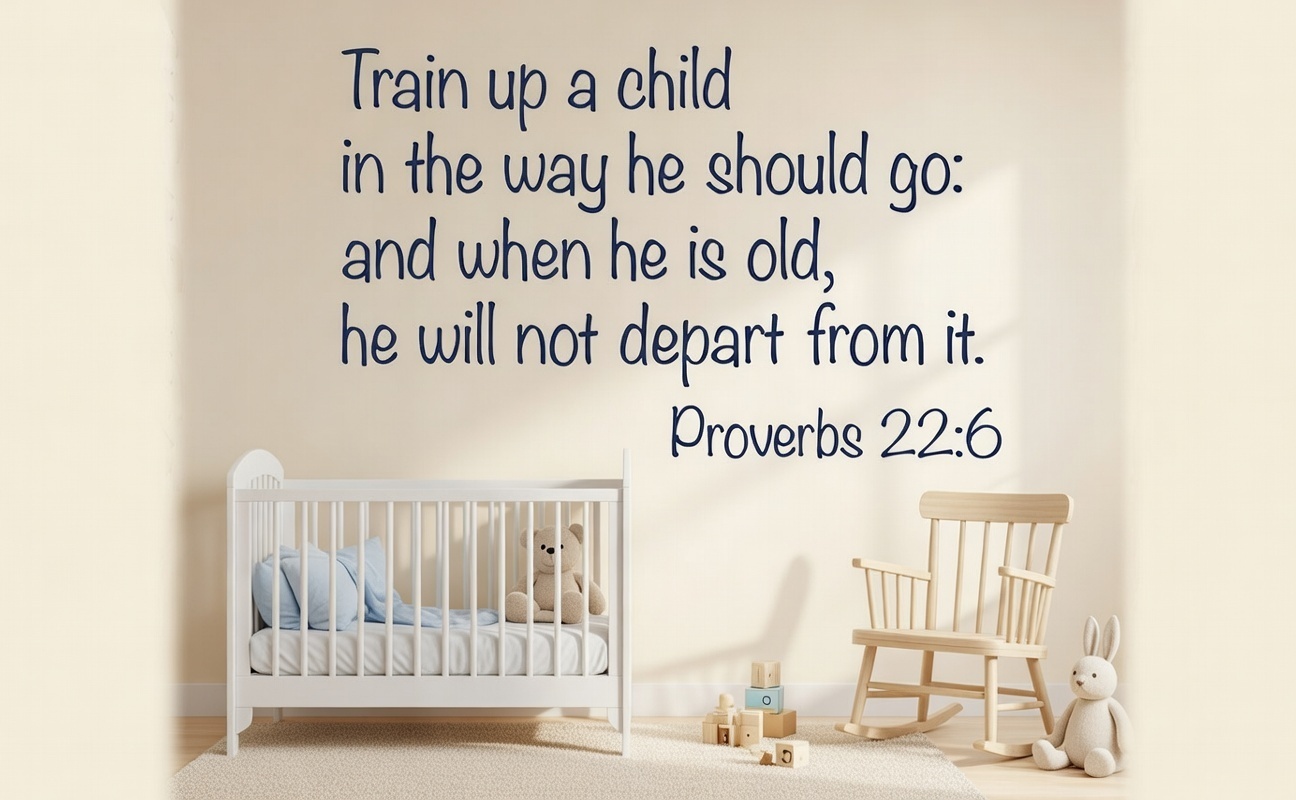
The Verse Across Translations
Different Bible translations render this verse in subtly different ways:
KJV: "Train up a child in the way he should go: and when he is old, he will not depart from it."
NIV: "Start children off on the way they should go, and even when they are old they will not turn from it."
ESV: "Train up a child in the way he should go; even when he is old he will not depart from it."
NLT: "Direct your children onto the right path, and when they are older, they will not leave it."
The KJV, ESV, and NASB versions are nearly identical. The NIV modernizes it, making "a child" plural and softening "train up" to "start children off." The NLT goes furthest, inserting "the right path" — a phrase that isn't in the original Hebrew.
That's where things get interesting.
The Hebrew Word That Changes Everything
The English phrase "train up" comes from the Hebrew word chanakh. It appears only five times in the entire Old Testament — and in the other four occurrences, it's translated as "dedicate."
- Dedicating a newly built house (Deuteronomy 20:5)
- Solomon dedicating the Temple (1 Kings 8:63)
- Dedicating the house of the Lord (2 Chronicles 7:5)
The Jewish festival of Hanukkah comes from this same root — it celebrates the rededication of the Temple.
So a more literal translation of Proverbs 22:6 would be: "Dedicate a child according to his way."
That reframes the verse entirely. It's not just about teaching rules or passing on knowledge. It's about consecrating a child — setting them apart with intention and purpose, the way Solomon dedicated the Temple.
There's even an ancient connection to the Arabic word from the same root, which referred to rubbing a newborn's gums with date juice to stimulate their first instinct to feed — a metaphor for creating an early appetite for wisdom.
"In the Way He Should Go" — Two Readings
The Hebrew phrase is al-pi darko, which literally means "according to his way." Notice: the word "should" doesn't appear in the Hebrew. Every English translation adds it.
This has led to two main interpretations that scholars have debated for centuries:
Reading 1: The Moral Path
The traditional reading: "the way he should go" means God's way — the path of wisdom and righteousness. Throughout Proverbs, there are fundamentally two paths: the way of the wise and the way of the fool. Parents are called to guide their children onto the right one.
This is the dominant interpretation among biblical scholars, and it fits the broader context of Proverbs, where "the way" consistently refers to moral direction.
Reading 2: The Child's Nature
A second interpretation, first proposed by the Jewish scholar Saadia Gaon in the 10th century, reads "according to his way" as according to the child's individual nature. Observe your child's unique temperament, gifts, and personality, then tailor your guidance accordingly.
This reading resonates with modern parents who recognize that each child is different and responds to different approaches.
Which Is Right?
Most scholars favor the first reading as the primary intent, but the two aren't mutually exclusive. Teaching your child moral wisdom while respecting their unique design isn't a contradiction — it's just good parenting.
Is This a Promise or a Proverb?
This may be the most important question about this verse, and it's one that many parents get wrong.
Proverbs 22:6 is a proverb — a statement of general wisdom — not a divine guarantee.
Biblical proverbs describe how life typically works, not how it always works. Scholar Tremper Longman III calls them "general rules of thumb." They express patterns, not contracts. "When he is old, he will not depart from it" describes what usually happens when parents invest deeply in their children's formation — not what is guaranteed in every case.
This distinction matters because many parents carry crushing guilt when adult children walk away from faith. They ask, "What did I do wrong?" or "Did God break His promise?"
The answer is that neither question fits. The verse was never structured as a conditional contract. It's an observation that early, dedicated formation tends to endure — and that is true. But it doesn't override a child's own free will. Proverbs itself acknowledges this: "Foolishness is bound up in the heart of a child" (Proverbs 22:15).
The verse offers real encouragement: how you raise your children matters deeply and has lasting effects. That's a powerful truth. It just isn't a guarantee — and understanding the difference brings freedom, not less faith.
The Historical Context
Proverbs is traditionally attributed to King Solomon (who reigned around 970-931 BC), though the book is actually a collection compiled over centuries. The section containing Proverbs 22:6 shares strong parallels with ancient Egyptian wisdom literature, showing that Israel's approach to teaching children was part of a broader tradition in the ancient world.
In ancient Israel, education was a family enterprise. There were no formal schools during Solomon's era. Fathers bore the primary responsibility for teaching their sons — both moral instruction and practical trade skills. Deuteronomy 6:6-9 commanded parents to teach God's words "when you sit in your house, when you walk by the way, when you lie down, and when you rise up." Education wasn't a separate activity. It was woven into every part of daily life.
That's the world Proverbs 22:6 was written for: a culture where a parent's dedication to forming their child was considered a sacred obligation, not an optional extra.
Why Parents Display This Verse
Proverbs 22:6 is one of the most popular Bible verses in nurseries and kids' rooms, and the reasons go deeper than decoration:
- It speaks directly to parental identity. Unlike verses about theology or personal devotion, this one addresses the role of being a parent. It validates the exhausting daily work by connecting it to something lasting.
- It is action-oriented. "Train up," "direct," "start them off" — this verse gives parents something to do. It frames parenting as a mission with purpose.
- It is hopeful. "When he is old, he will not depart from it." Every parent's deepest desire is that what they pour into their children will take root. This verse speaks to that hope.
- It marks a space as intentional. Putting this verse on a nursery wall is a declaration: this home takes the formation of children seriously. It transforms a room from merely functional into a space with stated purpose.
Vinyl wall decals are a natural way to display Proverbs 22:6 because the verse grows with the child. What starts as a nursery blessing becomes a daily presence as the child learns to read it themselves. And because decals are removable, the verse can move with the family — from the nursery to a big-kid room to a teenager's space and beyond.
For a verse about lifelong formation, having it physically present through every stage of childhood carries its own kind of meaning.
"Looking for more scripture for your home? See our full guide: 30+ Bible Verses for Your Home, Room by Room
Ready to display Proverbs 22:6 in your child's room? Our vinyl decal application guide walks you through every step — it takes about 15 minutes and no special tools.
